
Nifty call put options are among the most actively traded instruments on the NSE, yet many beginners freeze the moment they open an option chain. A wall of strike prices, OI columns, IV percentages and Greek labels stares back at them, and they either click away or, worse, place a trade they don’t fully understand. Many advisory teams fielding questions about Nifty call and put options daily report a consistent pattern: salaried professionals want a structured way to participate in index moves, while first-time traders have heard that options can multiply returns and want to understand the mechanics before they risk capital.
This article is built for that reader. No complex mathematics, no jargon left unexplained, and no overpromise about easy profits. What you’ll get is a working understanding of how calls and puts function, what drives option premiums, how to read a live option chain, when to buy a call versus a put, and what risks routinely catch beginners off guard. Read this once carefully, and the option chain will stop looking like noise.
What Nifty call and put options actually are
The core idea behind a call option
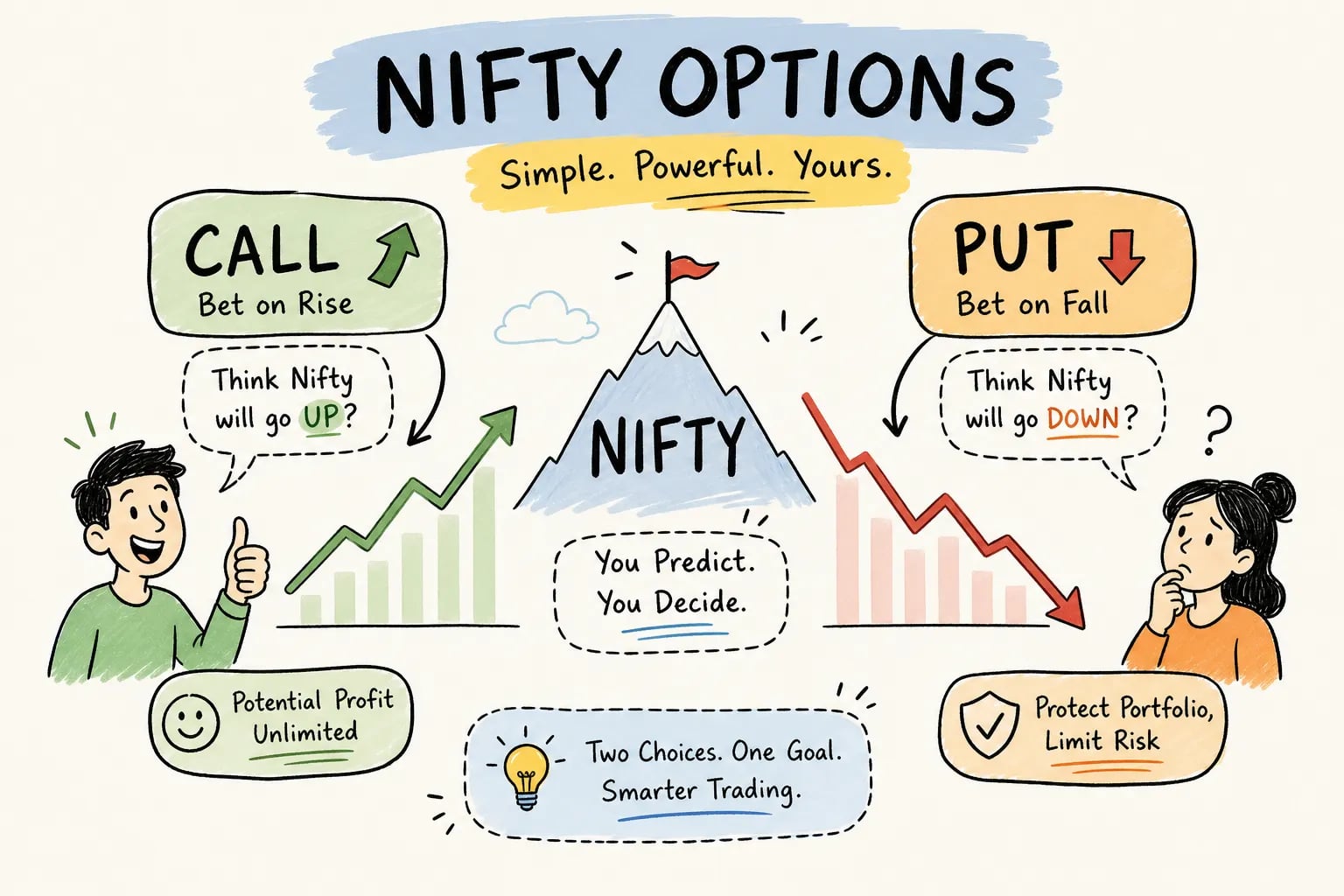
A Nifty call option gives you the right, but not the obligation, to profit from a rise in the Nifty 50 index above a specific level (the strike price) before a fixed date (the expiry). You pay a premium upfront to acquire this right. If Nifty is at 24,500 and you buy a 24,600 call, you are betting that the index climbs past 24,600 before expiry. As a buyer, your maximum loss is always capped at the premium you paid, nothing more.
The core idea behind a put option
A Nifty put option gives you the right to profit from a fall in the index below a chosen strike price. Puts are the natural instrument for expressing a bearish view or for hedging an existing equity portfolio against a sharp correction. When Nifty falls, a put premium rises in value. One important distinction worth noting early: Nifty is a cash-settled index option. There are no shares to deliver at expiry; only the cash difference between the settlement price and the strike is exchanged. This makes Nifty options simpler to manage at expiry than stock options.
Nifty call put options, what determines the premium
Intrinsic value vs. time value
Every option premium is made up of two components. Intrinsic value is how much the option is already “in the money” relative to the current Nifty level. If Nifty is at 24,500 and you hold a 24,400 call, the intrinsic value is 100 points. Time value is everything else: the additional amount the market charges for the probability that the option will move further in your favour before expiry. At-the-money (ATM) options, where the strike is closest to the current index level, carry the most time value and are the most actively traded strikes on any given expiry.
How implied volatility shapes Nifty option premiums
NIFTY implied volatility (IV) reflects the market’s expectation of how much Nifty will swing over a given period. Under normal conditions, Nifty IV ranges between 12% and 18%. When IV is low (below 12%), premiums are comparatively cheap. When IV rises above 20%, as it historically has around Union Budget announcements, RBI policy decisions, and sharp global sell-offs, premiums become expensive. Buying options when IV is elevated means you are paying for uncertainty that may never materialise, a costly mistake that beginners make repeatedly.
NIFTY option Greeks that matter most for beginners
You don’t need to master all four NIFTY option Greeks immediately, but two of them prevent the biggest early mistakes. Delta tells you how much an option’s premium moves for every one-point move in Nifty; ATM options carry a delta of approximately 0.5, meaning they move roughly half a point for every one-point index move. Theta is the daily cost of holding an option. It works against buyers and in favour of sellers, and it accelerates sharply as expiry approaches. Understanding these two alone puts you well ahead of most first-time options traders.
Reading the Nifty call put options chain
The layout: calls on the left, puts on the right
The NSE option chain is laid out with calls on the left side, puts on the right, and strike prices running down the centre column. The main columns on each side are: OI (open interest), Change in OI, Volume, IV, LTP (last traded price), Change, and Bid/Ask quotes. The strike closest to the current Nifty spot level is highlighted as the ATM strike and typically carries the highest liquidity, though this can shift intraday. Starting with the ATM row and reading outward in both directions gives you the clearest picture of where market participants are positioned.
What NIFTY OI (open interest) and change in OI actually signal
Open interest is the total number of outstanding contracts that have not yet been closed or settled. Rising OI alongside a rising price suggests fresh buying is entering the market (a long buildup), which supports a bullish view. Rising OI alongside a falling price signals fresh short positions being added (short buildup), which leans bearish.
The practical shortcut for reading the chain: heavy put OI accumulating at strikes below the current Nifty spot level signals that option writers are defending a support zone. Heavy call OI building above spot signals that option writers are treating that level as resistance.
Using IV on the chain to gauge sentiment
The IV column beside each strike shows how expensive options at that level are relative to historical norms. Strikes with unusually high IV are pricing in significant event risk or sudden directional conviction. Comparing call IV to put IV across the chain also reveals directional skew: when put IV is consistently richer than call IV, the market is pricing in a greater probability of downside. This skew is normal in Indian index options and is something experienced traders account for when selecting strikes.
When to buy a call vs. when to buy a put
Reading market conditions before entering a call
Buying a Nifty call makes sense when the broader trend is upward, momentum indicators confirm strength, and the option chain shows rising put OI at lower strikes (indicating support is building beneath the market). Weekly NIFTY options, which expire every Tuesday on NSE, work well for short directional trades lasting one to two days when a clear catalyst exists. Monthly options are better suited to situations where you expect a move to develop over one to three weeks, since they carry more time value and experience slower daily theta decay. The lot size for Nifty 50 options is currently 65 units per contract, revised by NSE with effect from January 2026.
Choosing puts in a declining or uncertain market
Buying a Nifty put is the natural trade when the index is falling or when you expect a sharp correction. Rising call OI above the spot level (acting as resistance) combined with a falling price and rising OI is a short-buildup signal that can support a put trade. One mistake beginners make here is buying deep out-of-the-money puts hoping for a dramatic crash. The odds rarely justify the premium cost, theta decay erodes the position quickly, and the required magnitude of move is usually far larger than what actually occurs. Stick to strikes close to the ATM level unless you have a specific reason to position further out.
Key risks every beginner must understand before trading Nifty call put options
Theta decay: the silent account drainer
Time decay is the single biggest trap for new options buyers. Every day you hold an option, its time value shrinks, even if Nifty barely moves. This effect accelerates in weekly Nifty options during the final two trading days before Tuesday’s expiry. Historical data from NSE weekly expiries indicates that an ATM weekly option can lose approximately 28% of its remaining premium on Monday and a further 48% or more on expiry Tuesday itself. Many beginners buy cheap, far out-of-the-money options hoping for a large move, then watch the premium erode to near zero even when Nifty eventually moves slightly in their direction, simply because they held too long.
Leverage amplifies losses as fast as gains
A single Nifty options lot requires a relatively small upfront premium compared to the notional exposure it represents. An unexpected global trigger, a sudden policy announcement, or a sharp gap opening can wipe out the premium within minutes. Position sizing matters more in options than in almost any other market instrument. A useful rule for beginners is to risk no more than 1% to 2% of total trading capital on a single options trade, regardless of how confident the setup appears.
Weekly vs. monthly options: which suits beginners better
Weekly Nifty options are cheaper in absolute premium terms, which makes them attractive, but they are also far more volatile in the final hours before Tuesday expiry. Gamma risk is at its highest near expiry, meaning premiums can swing violently even on modest index moves. A safer starting point for beginners is monthly options, or entering weekly positions early in the expiry week rather than holding into expiry day. Give the trade room to breathe, and have a pre-defined exit level before you enter.
Getting reliable live data and your first guided trades
Where to access the Nifty option chain
The NSE official website provides the full Nifty option chain with live data during market hours, from 9:15 AM to 3:30 PM IST. Weekly Nifty options expire every Tuesday; monthly contracts expire on the last Tuesday of the expiry month. If that Tuesday is a trading holiday, expiry shifts to the previous trading day. Platforms such as Sensibull and Quantsapp offer analytics built on top of the base NSE data, including visual OI charts, payoff diagrams and strategy builders. These tools are worth exploring once you are comfortable reading the basic NSE layout.
Why a guided service helps while you’re building skill
Reading an option chain and making high-probability trade decisions are two very different skills, and the gap between them is where most beginners lose money. Finversify bridges that gap with momentum-driven Nifty options picks that come with clearly defined entry levels, stop-losses and targets, so you learn by doing rather than by guessing. Every call includes the research rationale: which strikes are showing OI buildup, what IV conditions look like, and why a particular entry makes sense at that point in the expiry cycle. Over time, this builds genuine understanding of the chain rather than dependency on signals.
For those ready to take the next step, Finversify is SEBI-registered (Registration No. INH200008608) and delivers recommendations through dedicated client groups in real time, with a free channel available to explore before committing. Get in touch with the team to see how the approach works before subscribing.
What this means for your trading
Nifty call put options are not inherently complex instruments, but they punish traders who skip the preparation. Calls are your tool for bullish conviction; puts for bearish conviction. Premiums are driven by intrinsic value, time value and implied volatility, and theta works against every option buyer, every day. The option chain is a live map of market positioning, and reading OI, change in OI, IV and price action together is a skill that compounds in value the more you practise it.
Start by watching the option chain for two to three weeks without placing a trade. Build a feel for how premiums behave around events, how OI shifts intraday, and how rapidly weekly options decay in the final sessions. When you are ready to trade with real capital, work with a SEBI-registered advisory service that shares transparent trade rationale and defined risk parameters. The edge in nifty call put options trading is not speed or access to secret formulas. It is discipline, preparation, and the patience to wait for high-probability setups rather than chasing every move.