
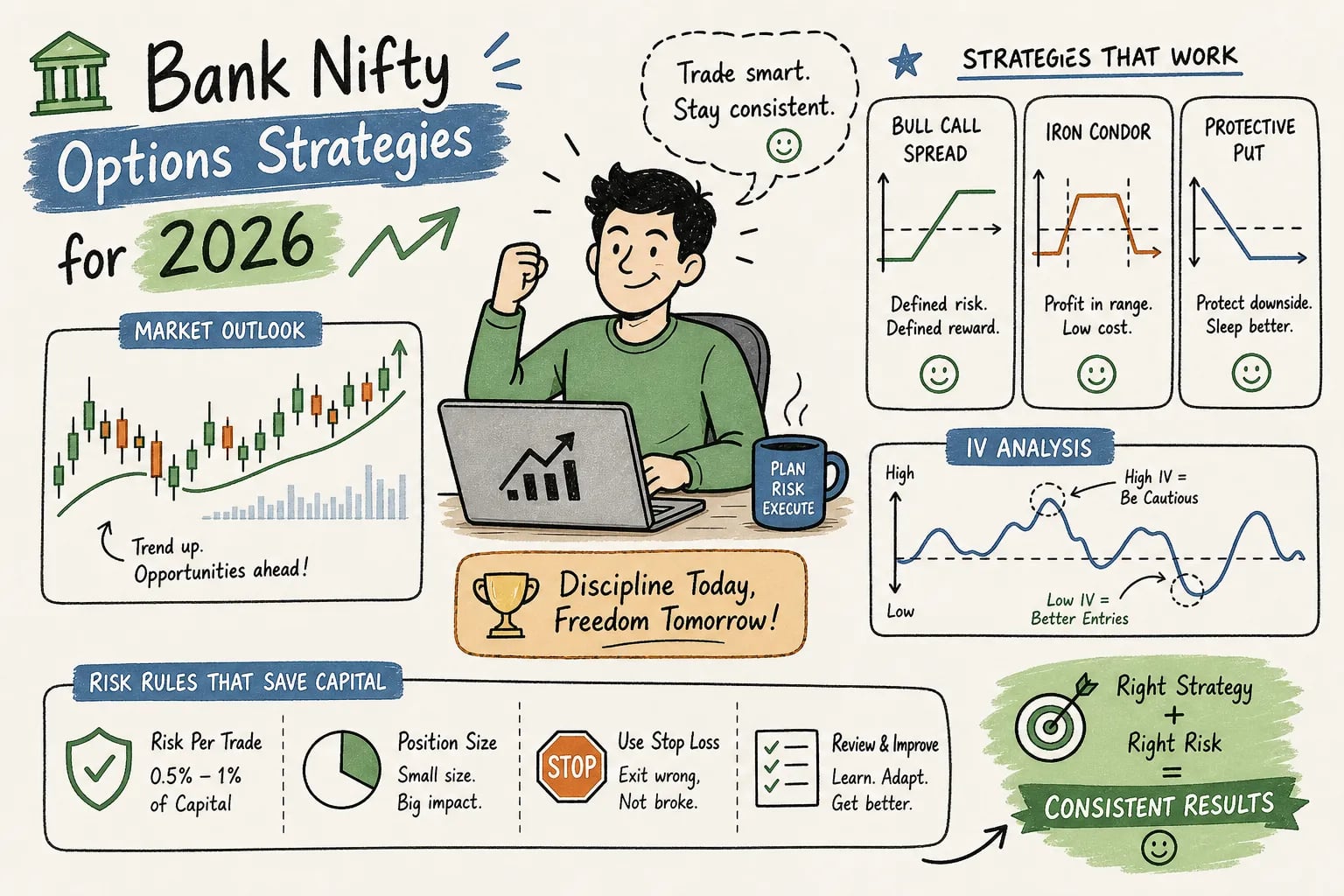
Meta description: What is the best strategy for trading Bank Nifty options in 2026? Learn entry signals, IV rank rules and risk sizing frameworks, start trading smarter today.
What is the best strategy for trading Bank Nifty options? It is not a single universal answer, and that is precisely what makes this index both compelling and dangerous. Bank Nifty is among the highest-traded index options on the NSE, drawing enormous participation from institutional desks and retail traders alike. The index routinely makes multi-hundred-point moves within a single session, and on event days those ranges can extend dramatically. Most traders who lose money here do not lose because of bad luck. They lose because they enter without a defined strategy, without understanding where implied volatility sits, and without a single rule on when to cut a losing position.
This article covers six Bank Nifty options strategies, each mapped to a specific market condition, with concrete entry and exit logic and a risk management framework you can apply immediately. Whether you are buying options for directional momentum or selling premium for range-bound returns, the goal is identical: a structured, rule-based approach that removes guesswork from every decision.
What Makes Bank Nifty Options Uniquely Challenging in 2026
The 2026 Contract Specifications You Need to Know First
Bank Nifty options now carry a lot size of 30 units, revised from the January 2026 series onward under NSE’s expiry rationalisation framework. Weekly expiries for Bank Nifty have been discontinued; the contract now settles monthly on the last Tuesday of the expiry month, shifting to the previous trading day if that Tuesday falls on a holiday. This change matters enormously for how you think about position sizing and holding duration.
Margin requirements vary by structure. A naked short call or put on Bank Nifty requires approximately ₹1.0 lakh to ₹1.5 lakh per lot under NSE SPAN rules, figures that shift with strike selection and prevailing volatility, while defined-risk structures like iron condors and credit spreads can reduce that requirement to roughly ₹25,000 to ₹60,000. Before you look at a single chart, these numbers determine how many positions your capital can realistically support. Always verify current margins with your broker or the NSE SPAN calculator before placing a trade.
How Theta Acceleration Changes Your Timing Around Monthly Expiry
Theta decay is not linear. It moves slowly in the early part of the monthly cycle and accelerates meaningfully in the final two to three trading days before expiry, reaching its steepest rate on expiry day itself. For option buyers, this means a directional move must materialise well before the expiry week to avoid paying for time that is already nearly exhausted. For sellers, those final days represent the most efficient premium collection window, but gamma risk is also at its highest, meaning a sudden move can reverse profits very quickly.
Why Intraday Range Demands Defined Rules Before Entry
Bank Nifty is a fast-moving index with frequent multi-hundred-point intraday swings, and on event days those moves can be substantially larger. This range is both the opportunity and the danger. Without a predefined stop-loss and a strike selection rule anchored to the current volatility regime, a trade that is directionally correct can still destroy capital through premium erosion or a sudden implied volatility spike. The index leaves little room for vague plans.
Six Bank Nifty Options Strategies and When Each Earns Its Keep
1. Directional Buying: Call and Put Options for Momentum Trades
Buying a call or put is the most intuitive approach but carries the lowest win rate of the six because theta decay and often inflated implied volatility work directly against the buyer. These trades work best when a clear momentum signal is already in place, the market is trending after a confirmed opening range break, and entry happens with enough time remaining in the cycle for the move to develop. The asymmetry is real: your maximum loss is capped at the premium paid, but you need a sufficiently large and fast directional move to profit after factoring in time decay.
2. Short Straddle and Strangle for Range-Bound Conditions
Short straddles and strangles flip the equation entirely. The seller collects premium upfront and profits if Bank Nifty stays within a defined range until expiry. Win rates are higher because range-bound price action is statistically more common than sustained directional moves. A short straddle on Bank Nifty typically requires approximately ₹1.2 lakh to ₹1.7 lakh in margin per lot, the exact figure varies by strike and volatility, so position sizing discipline is non-negotiable. These strategies are best deployed when implied volatility is elevated, such as in the post-event consolidation phase after an RBI policy announcement or budget day, when the IV crush has passed and the index is digesting the news.
3. Iron Condor and Vertical Credit Spreads as Defined-Risk Structures
Iron condors and vertical credit spreads occupy the middle ground. They profit from range-bound movement like naked selling, but the long option legs cap your maximum loss and reduce margin to roughly ₹25,000 to ₹60,000 per lot. A Bank Nifty iron condor is constructed by combining a short call spread and a short put spread placed around expected support and resistance levels, with the short strikes ideally sitting beyond high-OI walls. Based on indicative backtests covering recent monthly expiry cycles, iron condors on Bank Nifty have produced win rates broadly in the 58, 70% range, with maximum drawdowns typically contained within a modest percentage of deployed margin. Results vary with strike selection, execution costs and market conditions, so treat these figures as a directional guide rather than a guarantee. These structures are easier to manage emotionally because the worst-case loss is known from the moment the trade is placed.
4. Delta-Neutral Bank Nifty Trading With Ratio Spreads
Delta-neutral positioning involves structuring a trade so that small directional moves in Bank Nifty produce minimal profit or loss, profiting instead from the passage of time or a change in implied volatility. A common application is the ratio spread: selling two ATM or near-ATM options for every one you buy, creating a position that is initially delta-flat but collects excess premium. This approach suits traders who have a view on volatility direction (rising or falling) but not necessarily on price direction. The key risk is that large moves can produce uncapped losses on the unhedged short leg, making position sizing and stop management critical. Use delta-neutral Bank Nifty trading when you are confident about the volatility regime but uncertain about the directional bias.
5. Calendar Spreads for Exploiting the Volatility Term Structure
A calendar spread involves buying a longer-dated option and selling a shorter-dated option at the same strike. On Bank Nifty, this structure profits when the near-month option decays faster than the far-month option, a reliable dynamic in the final week before expiry. Calendar spreads work best when the volatility term structure is in contango (near-month IV lower than far-month IV) and the spot price is hovering near the chosen strike. Maximum profit is achieved if Bank Nifty closes at or near the short strike on expiry day. The defined risk is the net debit paid to enter the position.
6. Event-Driven Straddle Buying Before High-Impact Announcements
Before major scheduled events, RBI policy, Union Budget, FOMC, implied volatility typically rises as participants pay for protection and directional exposure. Buying an ATM straddle two to three days before the announcement exploits this pre-event IV expansion, provided the actual spot move after the announcement exceeds the straddle’s breakeven range. The discipline here is the exit: this is a pre-event volatility trade, not a directional bet. Close the straddle at or before the announcement if the IV expansion has already produced sufficient profit, because holding through the event risks a sharp IV crush that can eliminate gains even if the directional move is substantial.
Matching Each Strategy to Volatility Conditions and Your Capital
Using IV Rank to Decide Between Buying and Selling Premium
IV Rank measures where current implied volatility sits relative to its 52-week range. When IV Rank is above 70, options premiums are inflated relative to recent history, making buying expensive and selling structurally attractive. When IV Rank is below 30, premiums are comparatively cheap, which favours directional buying or debit spreads. This single filter eliminates a large number of incorrect strategy choices before you even check a price chart. If IV Rank and IV Percentile disagree, prefer defined-risk spreads over naked positions until the picture clarifies.
How Event Risk from RBI Policy, Union Budget and FOMC Changes the Playbook
Before major events, implied volatility typically rises as participants pay for protection and speculation. After the event, IV often collapses sharply. In recent RBI policy cycles, post-announcement VIX drops have ranged from approximately 2.5 to 4.5 points, with noticeable straddle premium compression in the sessions that follow. Union Budget announcements have historically produced a larger effect, with more pronounced VIX declines and sharper ATM straddle contraction. The practical rule: avoid buying options in the two to three days before a major announcement when IV is already elevated. After the event, if the spot move is contained, short premium structures like iron condors and credit spreads on Bank Nifty are the better fit. This is where the event-driven approach in the Nifty Bank options trading plan pays off, knowing the typical post-event volatility behaviour shapes both strategy selection and entry timing.
Capital Allocation Per Strategy Type
With a lot size of 30 and current margin requirements, here is a practical comparison of what each structure demands (figures are approximate and vary by strike and market conditions, always verify with your broker):
- Naked short call/put: ₹1.0 lakh to ₹1.5 lakh per lot
- Short straddle: ₹1.2 lakh to ₹1.7 lakh per lot
- Iron condor: ₹25,000 to ₹60,000 per lot
- Vertical credit spread: ₹20,000 to ₹45,000 per lot
Spreads and condors allow more efficient capital deployment with capped downside, while naked selling demands higher margin and deeper loss reserves. For most retail traders building a consistent track record, starting with defined-risk structures is the structurally sound choice.
Entry and Exit Signals That Reduce Guesswork
VWAP and Opening Range Breakout as the Directional Filter
The most reliable intraday entry trigger for Bank Nifty options is the confluence of two conditions: price holding above or below VWAP, and a confirmed breakout of the opening range high or low on a five to fifteen minute candle. Price above VWAP signals a bullish bias and supports call buying or put selling; price below signals the opposite. When VWAP is being crossed repeatedly in both directions, that is a no-trade signal, step back and wait for a cleaner setup. Published research on ORB-plus-VWAP systems applied to Bank Nifty suggests indicative win rates in the 50, 65% range with profit factors in the 1.2, 1.6 band, though actual results depend heavily on execution costs, slippage, and the specific filters applied. The real value of this system is not the win rate in isolation; it is the positive-expectancy foundation it provides when paired with strict stop-loss rules.
Reading OI Data and Price Structure for Strike Selection
High call OI at a specific strike acts as overhead resistance; high put OI acts as a support floor. Use the OI table from your broker terminal to select strikes that are not immediately running into a wall. A breakout above a heavy call-OI strike is a high-conviction long setup because the supply overhang is being absorbed. A rejection from the same level favours put buying or a call credit spread. This context prevents the common mistake of buying calls just as the market is running into a ceiling.
EMA Confluence for Confirming Trend Momentum
A 20/50 EMA crossover on a 15-minute chart serves as a trend confirmation tool, not a standalone entry signal. When the 20 EMA is above the 50 EMA, it confirms the bullish bias established by VWAP and opens the door for call buying or put selling. Use EMAs to avoid counter-trend trades even when a single candle looks tempting. The real value of this combination is filtering out at least two or three low-quality setups each session.
A Risk Management Framework for Every Bank Nifty Trade
The Reward-to-Risk Minimum That Separates Disciplined Traders
As a practical guideline, avoid placing trades with a reward-to-risk ratio below 1:1.5. If you are risking ₹5,000 in premium on a long option, your target should be at least ₹7,500. This threshold filters out a large number of mediocre setups that feel compelling in the moment but have poor structure. For spread sellers, calculate the ratio as follows: reward equals premium collected, maximum risk equals the width of the spread minus the premium received. The maths must work before the order goes in.
Stop-Loss Placement for Buyers Versus Sellers
For option buyers, one commonly used heuristic is to exit when the premium has fallen 30, 50% from the entry price. If you paid ₹150 for a Bank Nifty call, an exit in the ₹75, ₹105 range protects capital without cutting the trade on normal intraday noise.
For sellers and spread traders, the stop is defined either by the structure’s maximum loss or by a spot-price level at which the short strike is clearly breached. Never move a stop wider once the trade is live. That single discipline, consistently applied, is what separates traders who survive drawdowns from those who blow accounts.
When to Exit Early and When to Let a Trade Breathe
Exits should be planned at entry, not managed emotionally in real time. For long options, booking at least 50, 60% of maximum profit rather than holding to expiry is a sound practice. For iron condors and credit spreads, closing at 50% of maximum profit locks in gains and eliminates the residual gamma risk that makes the final hours before expiry genuinely dangerous. The discipline of early exits consistently beats the gamble of holding for the last few percentage points.
How Structured, Research-Backed Advisory Accelerates Consistent Execution
Most traders understand these strategy mechanics in theory but struggle to execute them consistently across a full month of shifting market conditions. Knowing when IV Rank is high, identifying the right OI structure, sizing positions correctly, and then holding discipline through three or four consecutive trades that do not work, that is the real challenge, and it is where a structured advisory framework genuinely earns its value.
Finversify is a SEBI-registered investment advisory (registration: INH 200008608) based in Hyderabad. It provides monthly Bank Nifty options picks with clearly defined entry levels, exit targets, stop-losses, and reward-to-risk guidance. Each recommendation includes the underlying rationale: the volatility regime it was structured in, the technical trigger, and the position sizing context. Before committing capital, verify the registration on the SEBI Intermediary Portal and review the firm’s public disclosures, this is the minimum due diligence any serious trader should perform with any advisory service.
When evaluating any advisory service, apply three tests: confirm it is SEBI-registered, check whether it publishes trade rationale alongside calls rather than just entry and target levels, and look for whether its track record includes losing periods transparently documented rather than only cherry-picked wins. Finversify operates a free Telegram channel specifically so prospective subscribers can observe the quality of calls and reasoning before subscribing. That level of transparency is the baseline standard any advisory worth following should meet.
What Is the Best Strategy for Trading Bank Nifty Options? A Practical Summary
There is no single answer to what is the best strategy for trading Bank Nifty options, the right choice depends on your risk profile, your available capital, and the current volatility regime.
Directional buying suits low-IV, high-momentum setups early in the monthly cycle. Short straddles and strangles suit post-event, range-bound markets where IV has already compressed. Iron condors and vertical spreads give you a middle path when conditions are uncertain and you need defined risk. Delta-neutral approaches and calendar spreads add precision when your volatility view is clear but your directional view is not. Event-driven straddle buying exploits pre-announcement IV expansion, provided you exit before the crush hits. Entry signals from VWAP, opening range breaks, and OI data sharpen your timing. A firm reward-to-risk minimum and a pre-planned stop-loss protect your capital on the trades that do not go your way.
For traders who have not yet built and backtested an independent framework, structured advisory from a SEBI-registered service offers both a practical starting point and an active learning environment. You learn what disciplined execution looks like by following it before you try to replicate it independently. Explore Finversify’s free Telegram channel to see what research-backed Bank Nifty options picks look like in practice, before committing to any subscription.