
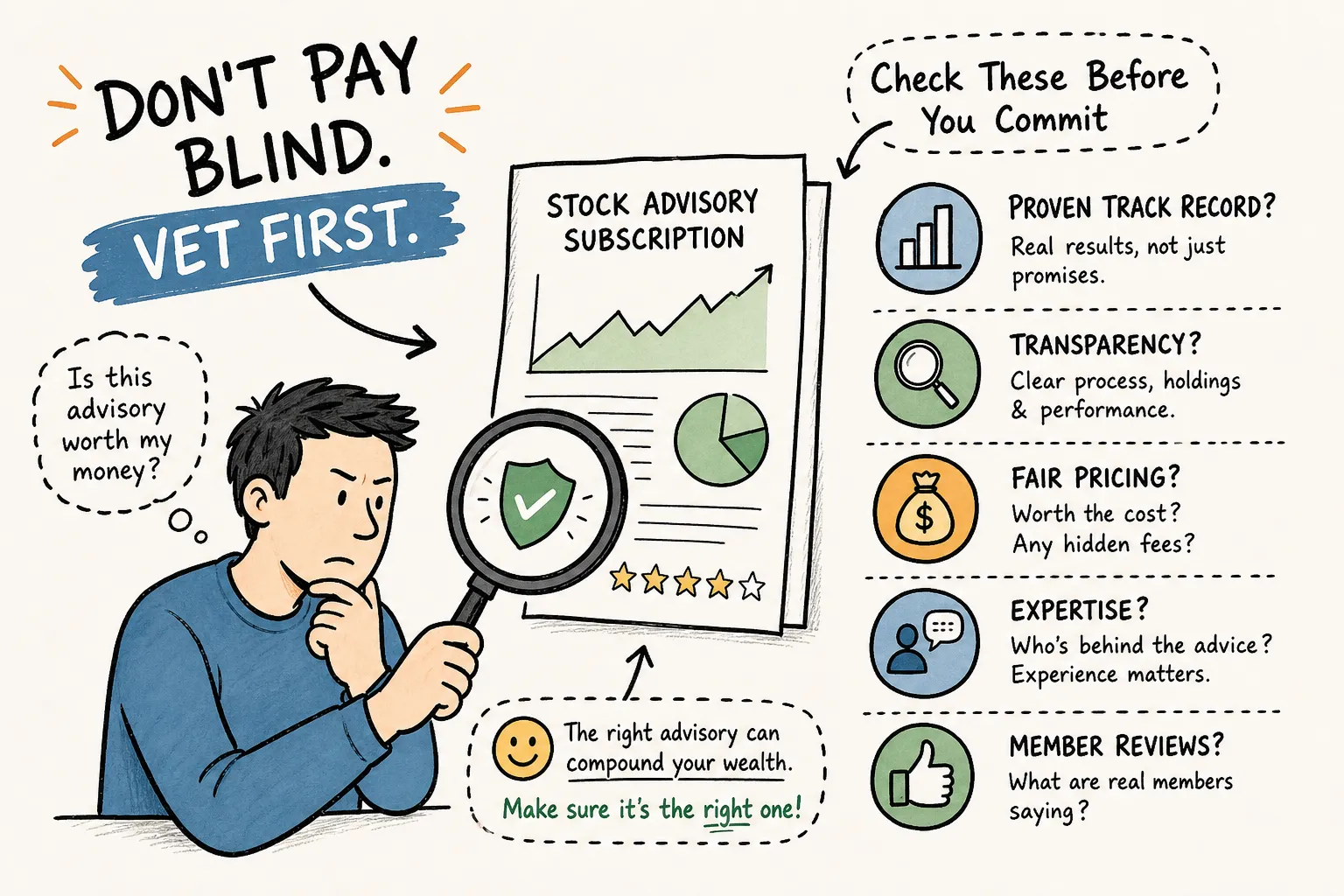
How do I evaluate a stock advisory subscription before paying, and how do I know I am not about to waste money on empty promises? These are the right questions to ask. Thousands of Indians pay for stock advisory subscriptions every month without doing any meaningful due diligence, and many regret it within 90 days. Many investors report that capital losses from following poor recommendations ultimately exceed what they paid for the subscription itself. The fee is rarely the biggest cost; acting on unverified, low-quality calls is.
Before you hand over a rupee, you need a structured pre-payment process, one that takes about 30 minutes but can protect you from months of frustration and real financial damage. This article walks you through a 10-point checklist, organised across five critical areas: SEBI authorisation, track record verification, research quality, fee clarity, and red flag screening. Work through each section in order, and you will have a clear answer on whether a service deserves your money.
The first filter: how do I evaluate a stock advisory subscription’s SEBI authorisation?
Verify the registration number directly on SEBI’s portal
SEBI maintains a publicly searchable intermediary database, and checking any firm’s registration status is straightforward and quick. Go to SEBI’s official website, navigate to the intermediary search, and enter the firm’s legal entity name or registration number. What you are confirming: the legal name, the registration number, the active or inactive status, and the registration category. These four data points must match exactly what the firm displays on its own website.
A legitimate service will publish its SEBI registration details prominently. Finversify, for instance, displays its registration number clearly on its website, look for it in the footer or the disclosures page, then cross-check it against the SEBI intermediary database to confirm it is active. That level of transparency is the minimum standard you should expect from any advisory you consider subscribing to. If you cannot find a registration number anywhere on a firm’s website, stop the evaluation immediately.
Know the difference between an RIA and a research analyst
This distinction matters more than most subscribers realise. A SEBI-registered Investment Adviser (RIA) provides personalised, suitability-based advice linked to your specific financial goals and risk profile. A SEBI-registered Research Analyst publishes general recommendations as research reports for a broad subscriber base. These are two different licences with different obligations, and confusing them leads to misaligned expectations.
Before you are onboarded, the registration category determines what disclosures and client agreements the firm is legally required to provide. If a firm cannot clearly state which registration it holds or why, that is a serious compliance gap, not an administrative oversight. Legitimate advisories answer this question without hesitation.
Mandatory disclosures a legitimate firm must provide
Before you pay anything, a SEBI-compliant advisory must be able to share a client agreement, conduct risk profiling, disclose its fees, declare any conflicts of interest, and provide a reference to SEBI SCORES for grievance redressal. These are not optional extras, they are regulatory requirements. A refusal or inability to produce any of these documents before onboarding is a clear disqualifier, full stop.
Scrutinising the performance track record, a core part of evaluating any stock advisory
What a credible track record actually looks like
A verifiable track record shows specific call dates, entry prices, exit prices, and realised returns. It is not a headline percentage floating on a landing page with no supporting data. Legitimate services maintain dated archives of their recommendations on their website or in downloadable call logs that any prospective subscriber can access before paying. Informal channels such as WhatsApp groups or Telegram chats are not a substitute for a proper dated archive on an official platform, if those are the only records on offer, treat that as a caution signal.
The keyword is “dated.” A recommendation record without timestamps is essentially unverifiable, and that is precisely the point for services trying to obscure poor performance. If an advisory cannot show you a timestamped history of its calls, treat the absence of data as data.
How to independently cross-check historical calls
The process is straightforward. Collect the original recommendation with its date and entry price, then verify the stock’s actual price on that date using NSE or BSE historical price data. Both exchanges publish daily security-wise price archives with open, high, low, and close figures, these are available through each exchange’s official website under their market data or historical data sections. Calculate the return from the signal date to the stated exit date using those official prices, then compare your number against the advisory’s claimed figure.
Pay attention to the return measurement convention. Close-to-close and open-to-close calculations produce meaningfully different numbers, and an advisory that does not specify which it uses is either sloppy or deliberately ambiguous. For a credible audit, download the exchange data, build a simple spreadsheet, and run the numbers yourself for at least 10 to 15 historical calls.
The look-ahead bias and cherry-pick trap
Some advisories quietly edit or delete losing calls from their archives. When you review a historical call log, ask yourself whether it looks suspiciously clean. A credible service will show its losing calls alongside its winners because that is what honest, rule-based advisory reporting looks like. A win rate of 100% is not a sign of excellence, it is a sign of selective reporting.
Testing research quality: an investment newsletter evaluation before you commit a rupee
What sample reports reveal about research discipline
Ask for sample reports or review the advisory’s publicly available content before subscribing to any paid stock tips service. In every call, look for defined entry levels, target prices, stop-loss levels, and holding-period guidance. A service that publishes vague “buy above X” calls without a stop-loss or target is not following a systematic process. It is guessing with structure, which is worse than guessing without it, because it creates a false sense of rigour.
Finversify maintains a free Telegram channel where prospective subscribers can observe live calls, review the research rationale, and assess the methodology before paying anything, check the channel and cross-reference a few calls against exchange data to judge its usefulness for yourself. That kind of pre-subscription transparency is the benchmark you should hold every advisory to. If a service refuses to show you live calls or sample reports before payment, that refusal tells you something important about how it operates.
Entry, exit, and stop-loss discipline as a quality signal
Every recommendation in a rigorous advisory carries a defined reward-to-risk ratio. In the author’s view, a useful working benchmark is a minimum of 1:1.5, meaning for every rupee risked, the potential gain is at least one and a half rupees. Calls that fall below this threshold suggest the service is not managing downside seriously; it is chasing upside without accounting for the cost of being wrong.
For options and futures calls specifically, also check whether the advisory specifies position sizing guidance or lot sizes. In derivatives, sizing directly determines risk exposure, and any service that gives you a futures or options call without lot size guidance is leaving you to manage the most critical variable on your own.
Holding period clarity and strategy consistency
An advisory should clearly state what kind of call it is making, whether it is a short-term trade, a swing position, or a longer-term momentum play, so that you can match it to your own trading style. Ambiguity about holding period is not flexibility; it is the absence of a defined process. Consistency in strategy across calls over time is a strong signal of structured methodology rather than opportunistic tip-giving dressed up as research.
Decoding fees, billing terms, and refund policies
Common pricing models used by Indian advisory services
Indian stock advisories typically use fixed-fee plans billed monthly, quarterly, or annually; AUA-linked fees capped at 2.5% per annum for RIAs; or hybrid models that add per-call or workshop charges on top of a base subscription. Annual plans are often marketed at a low per-day rate of ₹6 to ₹15 to minimise sticker shock. Always evaluate the total annual commitment, not the daily equivalent, because that is what actually leaves your account.
What to read carefully in the fine print
GST may or may not be included in the quoted price, verify the final checkout amount before entering payment details. Some services charge separately for additional tiers, premium alerts, or strategy calls that are presented as part of the core package during the sales conversation. Confirm whether the fee mode is locked for your onboarding period; industry commentary and SEBI-linked guidance indicate that a 12-month fee-mode stability period is commonly applied to client relationships, so clarify this in writing before you subscribe.
Trial periods and refund policies
Some credible advisories offer a 7 to 30-day trial period or a free public channel before requiring payment, though policies vary widely and trials are not universal, so do not assume one exists without confirming. Refund policies differ significantly across the market: some offer pro-rata refunds for unused subscription time, others exclude refunds once research has been accessed, and a few have strict no-refund terms for change-of-mind cancellations. Insist on seeing the written cancellation and refund policy before subscribing, not after. Refund processing timelines are typically quoted in the range of 7 to 15 working days by most providers, and refunds are generally returned to the original payment source, but confirm this in the service’s own terms before paying.
Red flags that should end the conversation immediately
Guaranteed returns, urgency tactics, and fake authority
Any advisory promising fixed, risk-free, or guaranteed returns is either uninformed about SEBI regulations or deliberately misleading you. SEBI explicitly prohibits such claims, and no legitimate registered service makes them. If you see those words anywhere in the sales material, treat it as a categorical disqualifier rather than an exaggerated marketing claim.
High-pressure tactics, “offer closes tonight” or “only 5 spots remaining”, are borrowed from sales scripts, not from disciplined investment processes. Be sceptical of testimonials that cannot be verified independently, or claims that high-profile investors use the service without supporting evidence. These tactics exploit urgency and social proof to bypass the stock advisory review process you are now equipped to run.
Opaque fees, no grievance mechanism, and poor communication
If you cannot get a straight answer about how a service is compensated, that opacity usually points to undisclosed commissions or conflicts of interest. A SEBI-compliant advisory must offer a grievance redressal mechanism and accept complaints through SEBI SCORES. The absence of either is not a minor service gap, it is a regulatory failure that signals deeper problems.
Test the communication quality before subscribing: send a specific query about a recent call or the research methodology, and observe how quickly and clearly it is answered. Evasive or templated responses during the evaluation stage are a reliable predictor of how the service will treat paying subscribers when things do not go to plan.
Your discipline, applied: the complete pre-payment checklist
The five sections above form a complete framework for evaluating any stock advisory before paying. Confirm SEBI authorisation and understand the registration category. Cross-check the track record against exchange data. Evaluate research quality through sample calls and methodology transparency. Read the fee structure and refund policy in full before paying. Screen for red flags and test communication before committing.
Any credible advisory will welcome this scrutiny rather than resist it. Finversify makes the evaluation straightforward from the outset: the free Telegram channel lets you observe real calls and assess whether the methodology matches how you want to trade, all before spending a single rupee. Review it as part of your standard evaluation process, alongside the SEBI portal check and track record audit described above.
If you work through these steps methodically, you will know exactly how to evaluate a stock advisory subscription before paying, and whether any particular service is worth trusting with your capital. The checklist exists to protect your money, but it also builds a broader habit: investing with discipline, not just in markets, but in the advisories you choose to follow. The time you spend verifying a service before subscribing is the same discipline that will protect your portfolio long after you do.